Est. reading time: 5 minutes
Everyone chases “viral,” but brands that consistently sell on TikTok aren’t lucky—they’re scientific. They treat attention like a system, not a slot machine. Here’s the playbook for engineering curiosity, building hooks that hold, leveraging creators without losing the brand, and scaling ROAS with ruthless precision.
Hack the Algorithm: Engineer Instant Curiosity
TikTok’s distribution engine rewards content that proves it can hold strangers, not just followers. Your mission in the first two seconds: signal novelty, clarity, and motion. Use a pattern interrupt—an unexpected visual, a provocative line of on-screen text, or a startling before/after—paired with fast kinetic framing (hard cuts every 1–2 beats, zooms, whip-pans). The algorithm watches for early signals like 2–3 second view rate, average watch time relative to length, rewatches, shares, and comments. Engineer for those outcomes from frame one.
Curiosity is a lever, not a vibe. Open loops (“I tried X so you don’t have to”), counterintuitive claims (“The ‘healthy’ habit that wrecked my skin”), and live demos trigger the brain’s novelty-and-reward circuitry, pulling viewers into the middle. Stack multiple micro-loops so every few seconds introduces a new question: what is it, does it work, what’s the catch, what does it cost? Close loops with proof before the next hook lands.
Design for sound-on culture. Use voiceover or text-to-speech to ride the beat; emphasize crisp consonants for intelligibility on mobile speakers. On-screen captions should be high-contrast and concise to pass the thumb-scroll test without audio. Favor big gestures, tactile demos, and conspicuous textures—satisfying visuals buy you watch time, and watch time buys you reach.
Craft Thumb-Stopping Hooks With Data-Backed Story
Great hooks are measurable assets, not happy accidents. Treat the first three seconds like a separate ad unit: A/B test opening frames, first lines, and on-screen text while holding the body constant. Analyze leading indicators—3-second view rate, hold to 25/50%, and retention curve shape—to choose winners. A hook that lifts the first five seconds by a small margin often compounds into outsized ROAS.
Structure your narrative with a beat map. The simple spine is: Problem (felt pain) → Pattern Interrupt (new angle) → Proof (demo, social validation, result) → Payoff (solve the pain now). Re-inject micro-tension every 2–3 seconds: switch angles, zoom, add a reaction cut, or pose a new question. Avoid brand stall—introduce brand presence early but light (packshot on desk, subtle watermark) and escalate prominence as proof lands.
Script for native behavior and search. Put primary keywords in the first line of on-screen text and caption to feed TikTok’s SEO surface. Keep on-screen text short and literal; punch up nouns and verbs users might actually search. Favor tactile, testable claims over adjectives, and demonstrate outcomes in-camera to reduce “too-good-to-be-true” friction.
Leverage Creators, Trends, and Frictionless CTAs
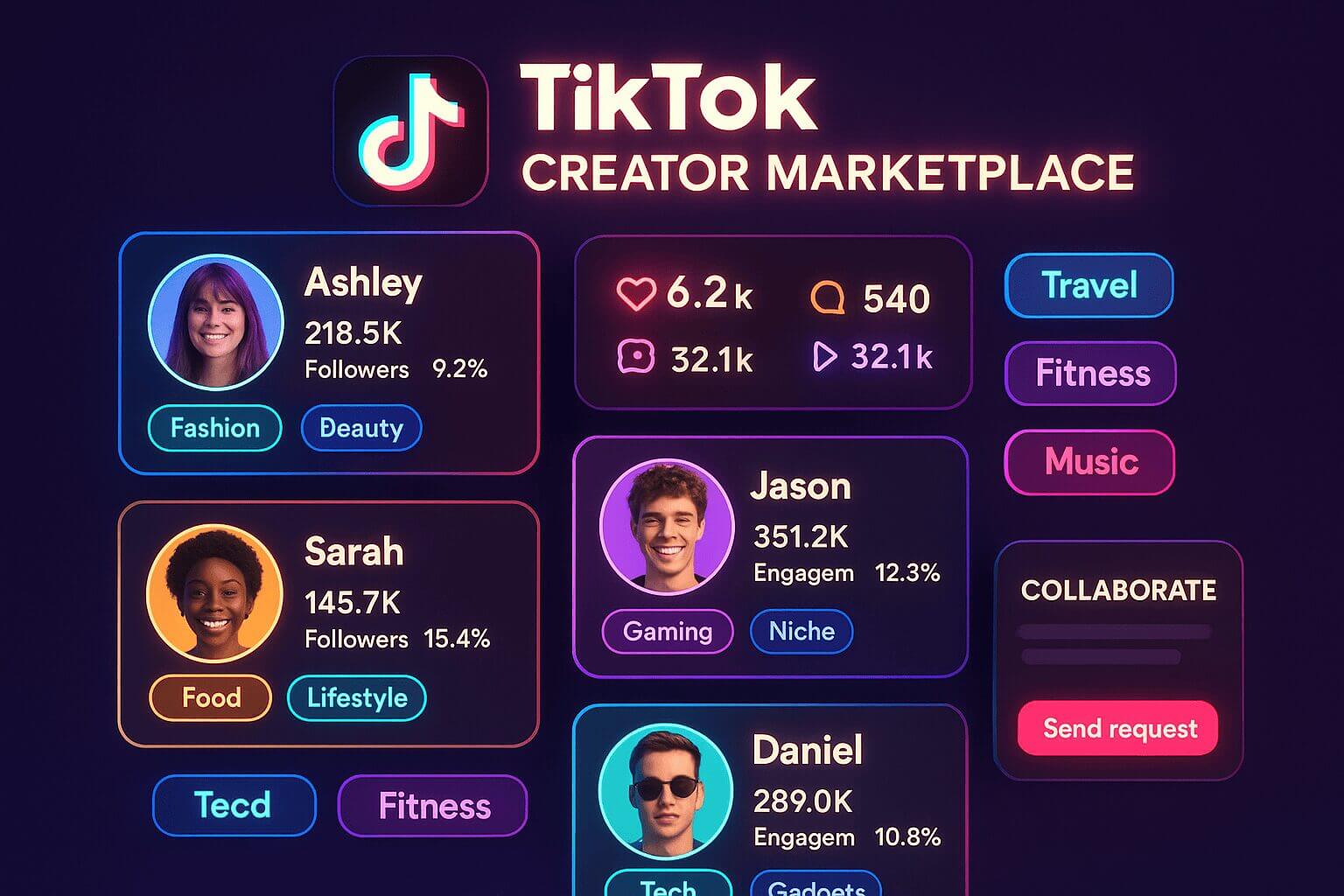
Creators are distribution multipliers and trust translators. Source via the TikTok Creator Marketplace or your own UGC roster, then brief for outcomes, not lines. Give them the angle, beats, and non-negotiables (claims compliance, brand guardrails), and let them speak in their own syntax. Whitelist top performers with Spark Ads to keep native social proof while unlocking paid scale.
Trends are accelerants when they fit the message. Use TikTok Creative Center to spot rising sounds, formats, and visual memes, then adapt with a relevance filter: if the trend doesn’t clarify your product’s promise in under five seconds, skip it. Remix formats like green screen, stitches, and duets to inject your proof into existing conversations without hijacking them.
Make action effortless. One clear CTA beats three competing asks—“Tap Shop to see your shade,” “Try it risk-free,” or “Build your bundle.” Place CTA micro-prompts at two moments: the first when curiosity peaks (usually right after proof lands), and the second as a clean end card with tappable affordances. If available, use native surfaces—TikTok Shop, Product Cards, Video Shopping Ads—to collapse discovery-to-checkout without bouncing users out of flow.
Measure, Iterate, and Scale ROAS With Precision
Run a creative lab, not a lottery. Separate testing from scaling: in a test campaign, isolate one variable (hook, angle, CTA, format) and let it reach a meaningful sample before judging. Score creatives on leading signals (3-second view rate, average watch time vs length, share and save rate), mid-funnel signals (25/50/75% completion), and lagging signals (CTR, CVR, CPA, ROAS). Leading indicators predict scaling potential; lagging indicators confirm it.
Build a creative scorecard and rotation rhythm. Cluster concepts by angle—Pain-Agitate-Relieve, Expert Explains, Challenge/Comparison, Unboxing/ASMR—and maintain multiple “active angles” to fight fatigue. Watch for decay: rising frequency with falling hold and CTR signals creative exhaustion. Refresh first frames and proof moments before rewriting entire scripts; often the opening and one proof beat drive most of the delta.
Scale with control loops. Use Spark Ads for winners to compound social proof, then broaden with lookalike or interest expansions once learning stabilizes. Allocate budget dynamically to creative, not just audiences: promote winners, cap underperformers, and keep 20–30% of spend in evergreen testing to catch the next breakout. Validate incrementality with geo or holdout tests when stakes rise, and keep your pixel and Events API clean so optimization has reliable targets.
Viral is a lagging indicator of value delivered fast. Engineer curiosity, weaponize data-backed storytelling, partner with creators who translate trust, and run a relentless measurement loop. Do this, and “viral” becomes repeatable—and repeatable becomes profitable.