The Situation
Florence Marine X is a premium surf and outdoor brand focused on performance-driven apparel and gear designed for demanding ocean and outdoor conditions. The holiday season represents one of the brand’s most important revenue periods, with multiple promotional moments compressed into a short window.
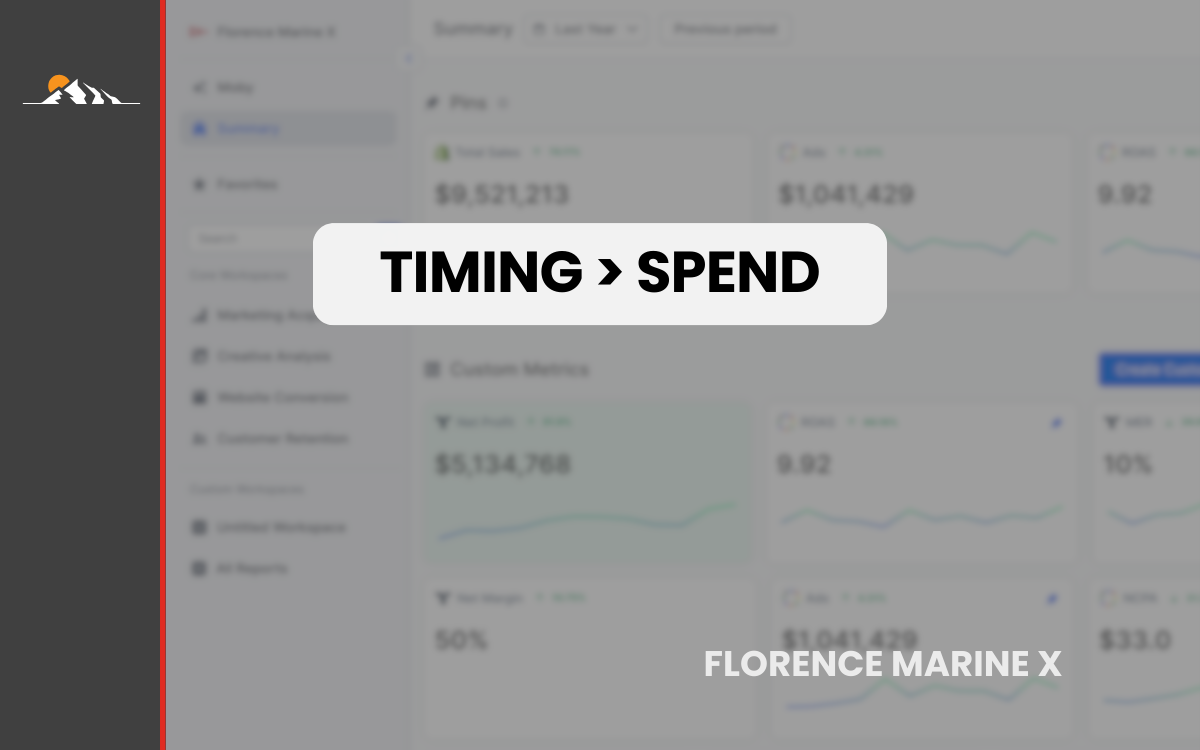
This analysis focused on November to December 2025 performance compared to the same period in 2024, using revenue data alongside Meta Ads and Google Ads spend. The intent was not to increase overall advertising pressure, but to improve how budget deployment and structure influenced outcomes during peak demand.
The Primary Challenge
Despite healthy demand, the paid media accounts were carrying structural and timing inefficiencies that limited performance during key promotional events.
Campaign structures were overly complex, with overlapping segments and budgets spread evenly across both low- and high-intent days. Meta and Google Ads were operating largely in parallel rather than as a coordinated system, and much of the product catalog was underutilized in favor of a narrower set of top sellers.
As a result, spend was diluted ahead of major moments like early access offers, BFCM, and end-of-year sales, reducing the ability to scale efficiently when demand was highest.
The Goal
Success was defined as stronger holiday-period revenue performance without relying on blanket spend increases. The objective was to improve efficiency and scale by concentrating budget during peak-intent windows, simplifying account structure, and coordinating Meta and Google Ads to work together more intentionally.
Our Approach
The strategy centered on restraint, sequencing, and coordination rather than aggressive daily optimization.
Instead of pushing spend evenly throughout the season, we prioritized preserving budget ahead of major promotional windows. Campaign structures were simplified to remove internal competition and concentrate spend on proven performers. Automation was used selectively to expand product coverage without adding operational complexity.
Most importantly, Meta and Google Ads were treated as complementary channels, each with a clear role during peak demand periods.
Execution Highlights
Unnecessary complexity was reduced across both platforms by closing campaign gaps, removing low-performing segments, and tightening structures ahead of Q4.
Spend was intentionally slowed leading into major promotions to preserve budget for high-intent days, preventing fatigue and premature exhaustion before key events.
Meta dynamic campaigns were expanded to ensure the full product catalog was actively represented, improving discovery and revenue density without requiring constant creative rotation.
Google Ads budgets were staggered to align with Meta activity, allowing Meta to drive scale and discovery while Google focused on capturing high-intent demand during peak windows rather than competing for the same budget pressure.
Results
Compared to November to December 2024, the 2025 holiday period delivered consistently stronger overall revenue performance and meaningfully more efficient results during promotional windows.
Performance improved most noticeably during early access promotions, Black Friday, Cyber Monday, and end-of-year sales. Return on high-spend days improved, and revenue contribution expanded across a broader range of products rather than remaining concentrated in a small subset.
These gains were achieved through tighter budget control and improved timing, not through indiscriminate increases in ad spend.
Why This Worked
The approach held up because it prioritized discipline over activity. By resisting the urge to spend aggressively every day, budget was available when customer intent peaked. Simplified structures reduced internal competition, and automation was applied where it added leverage rather than noise.
Coordinating Meta and Google Ads as a single system, rather than siloed channels, improved overall efficiency and clarity during the most important moments of the quarter.
Strategic Takeaway
This engagement demonstrates how holiday performance can be improved through structural discipline, intentional budget timing, and thoughtful channel coordination.
For brands with compressed promotional calendars and high seasonal demand, this approach leads to clearer decision-making, stronger peak performance, and a more scalable paid media foundation moving forward.