

The Situation
Mailchimp regularly partners with agencies to help customers assess and improve their email marketing programs. On paper, these audits are meant to surface insights and opportunities.
In practice, most fall short.
They identify issues but do not establish priorities. They surface data but do not create clarity. They leave stakeholders with a long list of observations and no narrative tying them together, no sense of sequence, and no confidence about what to do next.
The audit was delivered as part of a Mailchimp partner engagement with an added expectation. It needed to do more than diagnose problems. It needed to support real strategy, align with Mailchimp’s ecosystem, and position us as a credible long-term partner rather than a one-off consultant.
The Primary Challenge
The work had to be technically thorough without being overwhelming, clear to non-technical stakeholders, and strong enough to support follow-up strategy and upsell conversations.
That meant turning the audit into a story rather than a checklist. Most audits fail at this because they treat findings as the deliverable. The findings are not the deliverable. The decisions the findings enable are the deliverable, and that requires a structure most audits never bother to build.
Our Approach
We treated the audit as a guided walkthrough, not a static document.
Rather than emailing a PDF and hoping it landed, we held the audit until it could be presented live. That meant the findings arrived with context, sequencing, and explanation built in. Stakeholders understood the reasoning before they had to absorb the details.
We structured the audit around three layers: what was working and worth protecting, what was limiting performance and worth addressing, and what should happen next and why. Technical depth was used where it earned its place. Everywhere else, plain language led. Every recommendation was tied directly to a clear next step so the audit functioned as the beginning of a plan, not the conclusion of a project.
Execution Highlights
Narrative-First Delivery
We presented the audit live before sharing it. Stakeholders understood the reasoning behind the findings before reading the bullet points, which changed how the document was received when it eventually circulated. The same audit lands differently when the reader already knows the story it is telling.
Strategic Framing Over Feature Commentary
We positioned recommendations in terms of business outcomes and lifecycle impact, not Mailchimp features or settings. The point of every finding was what it meant for the customer’s revenue, retention, or operational efficiency, not which toggle in the platform needed to be flipped.
Partner-Aligned Positioning
The audit reinforced our role as a strategic partner operating within Mailchimp’s ecosystem, not an external critic pointing out flaws. That distinction matters in partner work. Audits that read as criticism create friction even when the criticism is correct. Audits that read as collaboration create momentum.
Upsell-Aware Structure Without Sales Pressure
Findings naturally supported future advisory and optimization work without forcing a pitch. The structure made the next engagement obvious without requiring it to be sold, which is a healthier dynamic for both the customer and the partner relationship.
Results
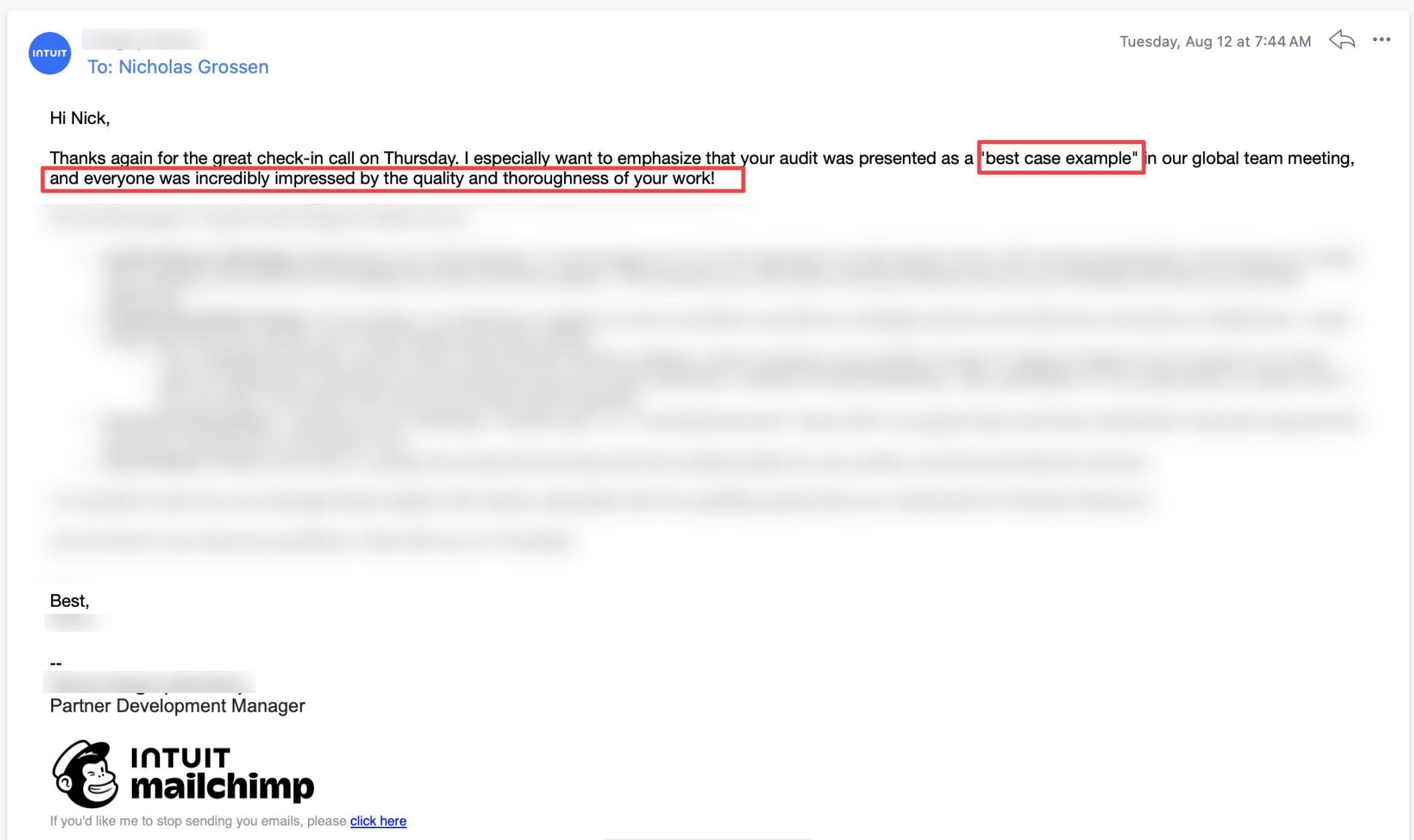
Intuit selected our audit and presented it internally as a “best case example” during a global team meeting, with specific praise for its quality, clarity, and thoroughness.
It generated positive feedback from the Mailchimp Partner Development team, reinforced our positioning as a trusted strategic Mailchimp expert, and created clear momentum for follow-up advisory work. The recognition was not for being flashy. It was for being clear, grounded, and genuinely useful.
Strategic Takeaway
The difference between an audit that lands and an audit that gets archived is rarely the depth of the analysis. It is the structure of the delivery.
When audits are framed as narratives, presented with context, and tied to specific next steps, they stop functioning as reports and start functioning as strategy. Stakeholders walk away with confidence about what to do next, not just awareness of what is broken. That is what turns a one-time deliverable into the beginning of a longer strategic relationship.